It's not what you say. It's how you say it.
Everyone's heard that line, usually just after they've pressed send. Cantis tells you before: how your message will land with the person you're writing to, and a better way to put it if you want one.
For Windows, inside Outlook and Teams, and still in testing. Sign up to hear when it's ready, or get free early access to a beta version.

How often tone is read the wrong way, and the time poor communication takes
Reading tone in an email, people were sure they had got it right 89% of the time. They were right 63% of the time.
In the study, more than a third of the emails were read the wrong way, by readers who were sure they had read them right.
Kruger, Epley and others, Journal of Personality and Social Psychology, 2005Seven in ten people at work spend a few hours or more every week on work caused by poor communication. The cause they named most often was different communication styles.
The Economist Intelligence Unit, Communication barriers in the modern workplace, 2018. A survey of 403 people at US companies, paid for by LucidchartThe same email lands differently with each person who reads it.
Pick a face to see how a few words land with a client of four years, a client of two weeks, and a supplier who's already late.
Everyone on this page is made up. If one of the messages looks like something you sent at nine last night, that's a coincidence.
Everyone on this page is made up. If one of the messages looks like something you sent at nine last night, that's a coincidence.
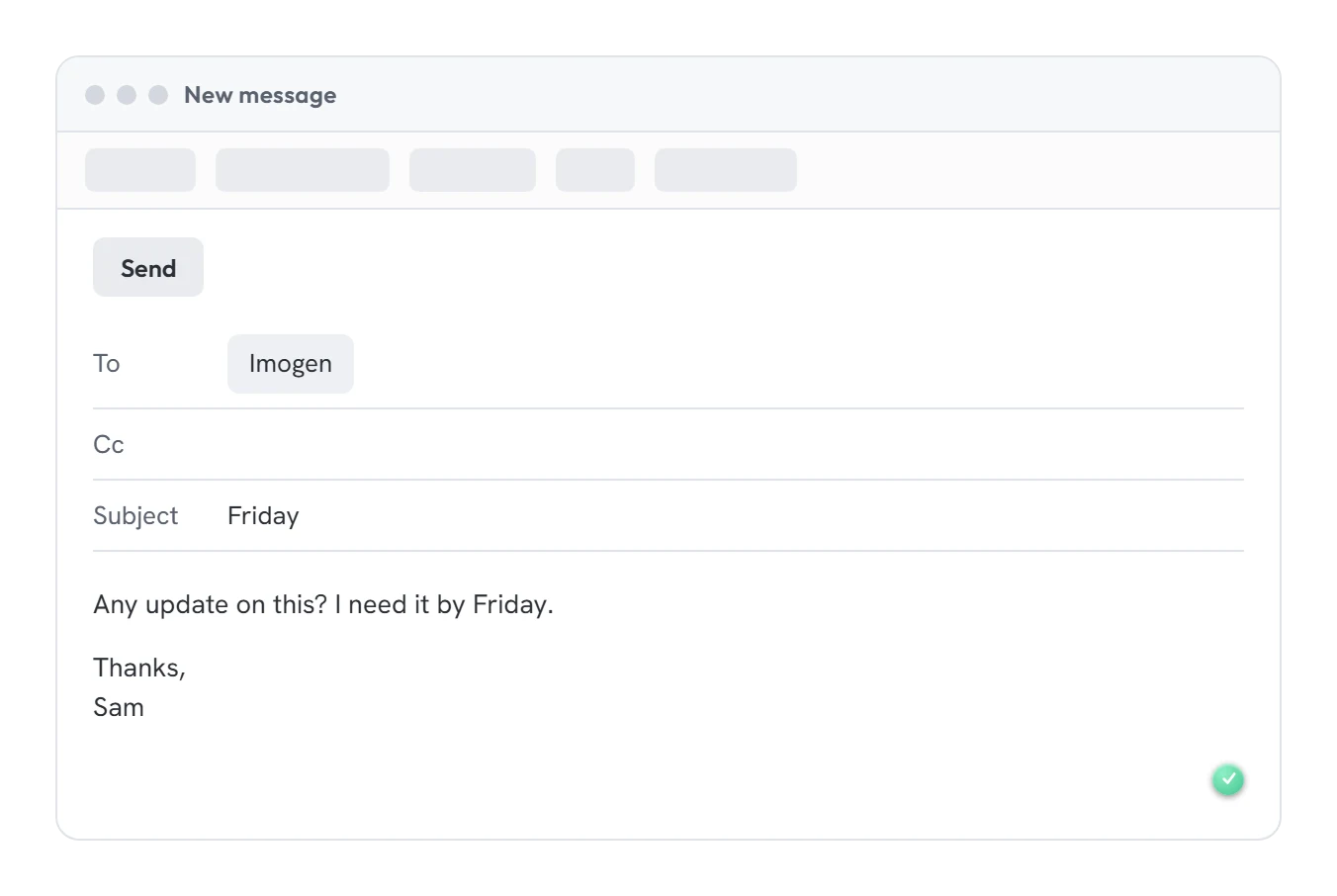
Subject: Friday
Any update on this? I need it by Friday. Thanks, Sam
Gareth
Supplier. Account manager.
- Relationship health
- 52falling this month
- Relationship
- Eighteen months. Weekly while a project's running.
- Communication style
- Brief. Slower to reply once a thread's been chased.
- Situation
- The delivery's late. You've chased twice on this thread.
- What works well
- Saying once, plainly, what happens if it's late, and asking what would help.
Escalation
Red. Read this one again.
You've already asked twice on this thread. A third one-liner with a date in it looks like the start of a dispute, whatever you meant. Say once what happens if it's late, and ask what would make Friday possible.
Suggestion
“Friday is the last day I can take this without moving the board date. What would make Friday possible from your side?”
 See it in the app
Tariq
Client. Joined as finance lead this month.
- Relationship health
- Too early to score. Four emails isn't a history yet.
- Relationship
- Two weeks. Four emails so far.
- Communication style
- Formal and complete. A greeting, full sentences and a sign-off, within a day.
- Situation
- Your first deadline together. You haven't chased him yet.
- What works well
- A reason with every request, and an easy way to answer.
Ambiguity
Amber. One thing to look at.
Tariq hasn't seen you chase anything yet, so “any update” will read as a complaint rather than a question. Say why Friday matters and make it easy for him to answer.
Suggestion
“Is there anything I can send over to help with this? Friday would give us a day in hand before the board pack goes out.”
 See it in the app
Imogen
Client. Operations director.
- Relationship health
- 88steady
- Relationship
- Four years. You write most weeks.
- Communication style
- Short and informal. First names, two lines, the same day.
- Situation
- Nothing unusual. The last twelve threads closed without a chaser.
- What works well
- Putting the ask in the first line. She doesn't need the reason.
Nothing to raise
Green. Checked, nothing to raise.
You've swapped short emails for four years. She'll read this the way she reads all the others.
Suggestion
Nothing to raise. It's still your call whether to send.
 See it in the app
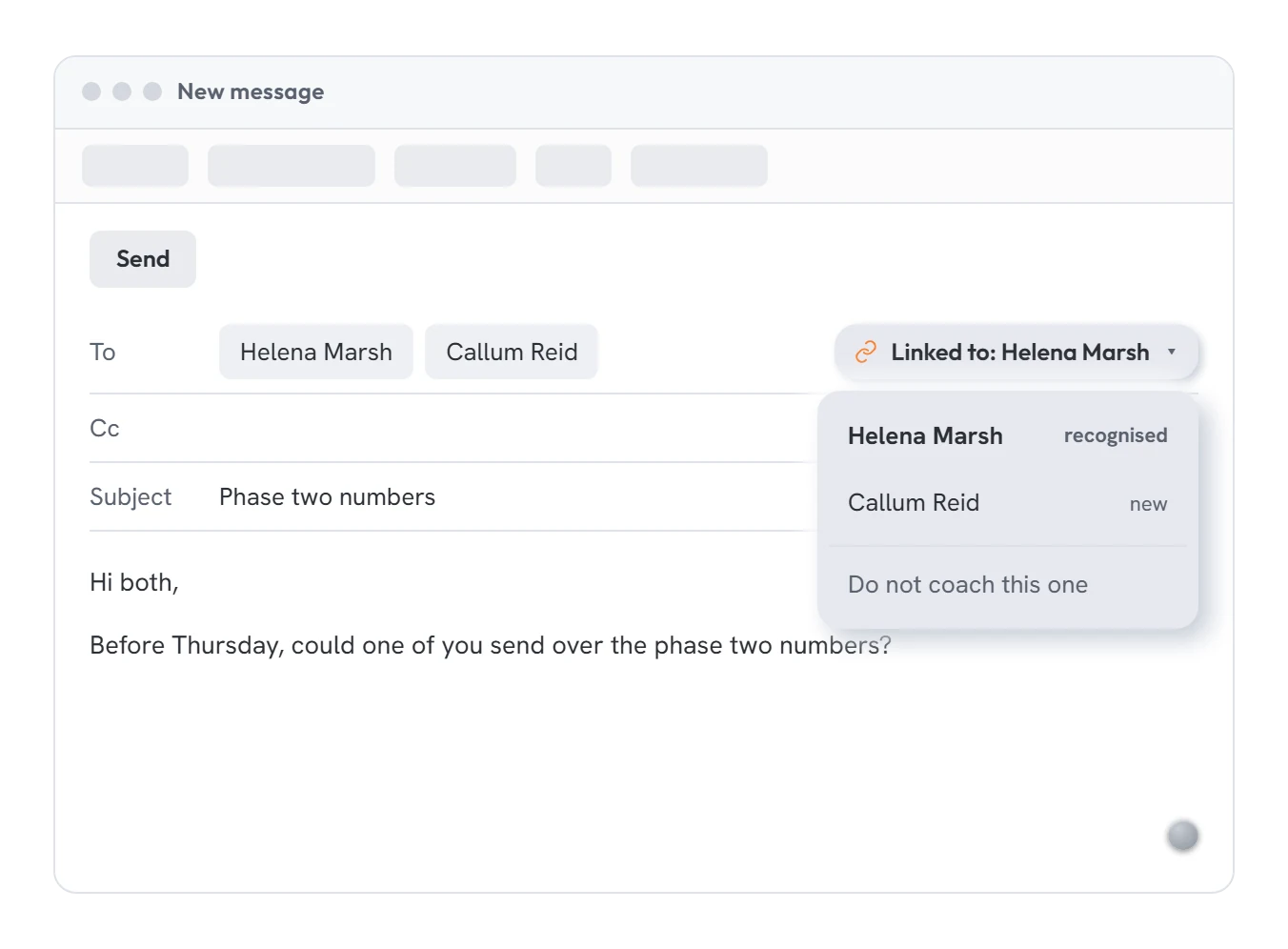
It knows who you're writing to.
-
With multiple names in the ‘To’ field, it allows you to choose which one to coach for.
Coaching is for one person at a time, so you choose which relationship it thinks about.
-
You'll hear from it less as time goes on.
Because it always tells you why, you learn the reasons. After a year with the same client you need the rewrite less, and the light's green more often.
It tells you why before it suggests anything.
Think of a colleague reading over your shoulder, without the sighing.
Cantis names the problem first, explains why it matters to this person, and only then offers a rewrite. Take it, change it or ignore it.
- The kind of problem.
- The words that set it off.
- Why it matters to this person.
- A suggestion, and an example rewrite.
- Accept or Reject. It's your call.
It doesn't stop at tone. The same check picks up the messages that could cost you more than a relationship: the ones that a solicitor or HR would want to see first, and the ones taking company information out of the building. Emails turn up in disputes years later, usually with a highlighter on them.
- 18%
of personal data breaches reported to the UK regulator in 2025 were an email sent to the wrong person. It has been the most common kind every year since 2021.
ICO, data security incident trends, 2025 - 44%
of people in Great Britain had conflict at work in the past year: disagreements, disputes or difficult working relationships. Acas calls it the highest level ever reported in a survey of workers here.
Acas, How prevalent is individual conflict at work in Great Britain in 2025?
Cantis checks every message against 18 kinds of risk. Here are seven.
Escalation
Threats, ultimatums, going over someone's head.
If this isn't fixed by Friday, I'll go straight to your director.
Trust erosion
Shifting the blame, a passive-aggressive aside, a promise quietly dropped.
As I said last week, this was never on our side.
Blame and accusation
An accusation dressed up as a question.
Did nobody check this before it went out?
Power dynamics
Undermining someone, or criticising them in front of other people.
Copying in the team so everyone can see where this went wrong.
Defensiveness
A reply that'll make things worse.
I did exactly what the brief said, so I'm not sure what the problem is.
Ambiguity
Easy to read as hostile or dismissive.
Fine, do it your way.
Legal and HR risk
Including company information that's about to leave the business.
I've attached the full client list so you can hit the ground running.
What you wrote, and what they read.
Some phrases arrive carrying a meaning nobody typed. Cantis picks up phrases like these when they're likely to land badly with the person you're writing to.
ClickTap a card to see what they read
Translations are approximate. Some are generous.
For people whose work depends on a handful of relationships.
Most of what you send goes to the same few people, the six or so who decide whether next year happens. And you're often writing to them at the end of a long day.
Sound familiar? Then Cantis can help.
- You read an important email five times before you send it.A green light means it's been checked and there's nothing to raise. That's time back, and fewer drafts called “final final v3”.
- You've been told your messages come across as blunt.And you meant nothing of the sort.
- English is your working language, not your first.A plain request in one country can read as rude in another.
- You've just started managing people.Or it's your first office job, and you're working out how to write to the people above and below you.
- There's one client, or one manager, who makes every message hard.Most people have had one.
- You find it hard to tell how people will take what you write.Some people read tone without thinking about it, and some don't. Cantis does that part for you, and tells you why.
You won't have to change how you write.
-
Write the way you always do.
In Outlook or Teams, the email you were going to send anyway. There's nothing to copy and paste, and no extra window.
-
A small light shows where it's got to.
Grey means nothing to raise yet. Blue means it's thinking. Green means it's checked and found nothing, and it's still your call whether to send. Amber or red means it's found something, and the number tells you how many.
-
It tells you why, then offers a rewrite if you want one.
Accept swaps the flagged sentence for the rewrite. Reject keeps your words. Then you send it, or you don't.
Outlook and Teams. For now.
The average worker gets 117 emails and 153 Teams messages a day. Cantis sits in the corner of the box you're typing in, in both, and there's nothing new to open.
Microsoft, Breaking down the infinite workday, 2025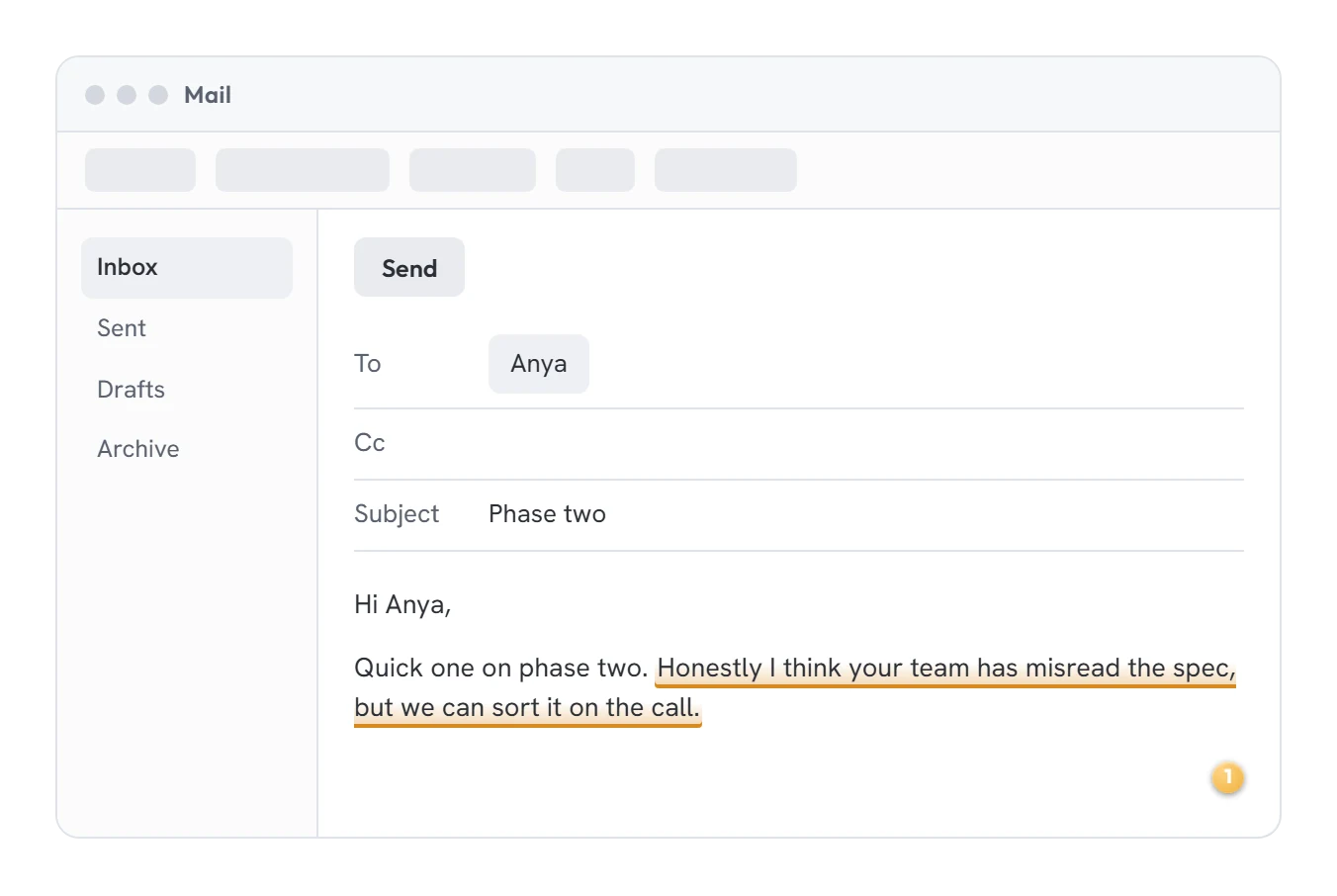
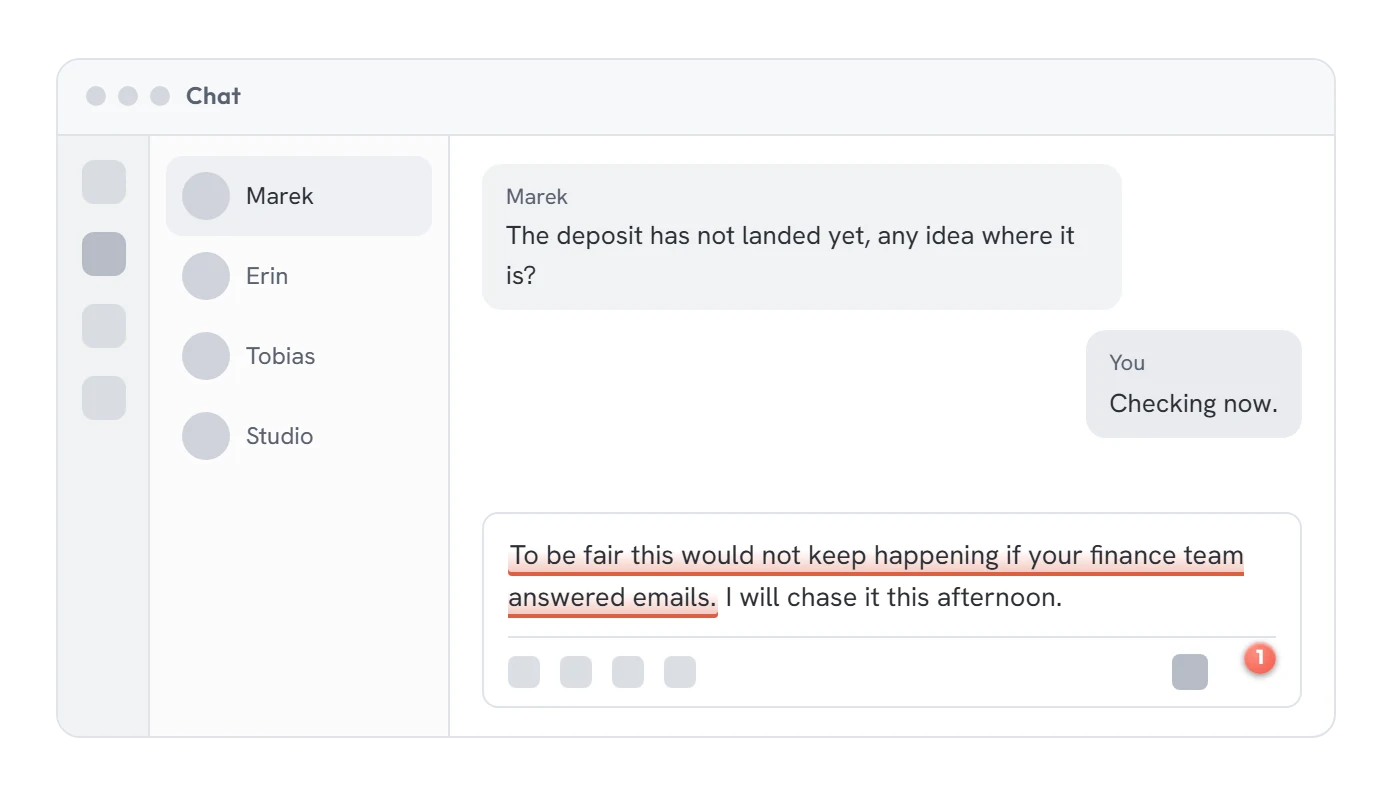
It isn't a grammar checker, and it isn't a chatbot you have to go and talk to.
A grammar checker reads every email the same way, whoever it's going to. Keep whatever you use for grammar. Cantis does a different job.
A grammar checker
- Fixes the spelling and leaves the meaning alone.
- Treats a client of four years exactly like a stranger.
- Underlines a word and never tells you why.
- Has no idea the paragraph you pasted in belongs to your employer.
- Lives in another window you have to go and open.
- Thinks “as per my last email” is perfectly fine.
Cantis
- Reads the whole message the way the person getting it will.
- Coaches you for the person you're writing to, and gets better the more you write to them.
- Tells you why before it offers a rewrite.
- Works in the box you're already typing in.
What happens to what you write
Today, and where it's going.
Today, analysis runs through our private cloud. We are building Cantis to run entirely on your device, and that is the product we intend to ship.
Whatever passes through that cloud is sealed. We can't open it, and nobody here can read what you wrote. In the app, the only time anyone at Cantis sees your words is when you send us feedback and tick the box to include the message.
What it runs on, and what it reads.
Today it runs on Windows. It works inside Outlook and Teams. Next, with no dates promised: Slack, Mac, maybe a phone app or a browser extension, and the on-device model.
Cantis only reads the words you type. It never looks at how you type, how fast, or anything else about you.
Fair questions.
Will it send, block or hold my messages?
Never. Nothing goes until you press send. Cantis doesn't have a send button and can't stop yours.
My employer wants to buy it. What would they be able to see?
We're happy to sell licences to businesses, and that's where it ends. Whoever pays for the licence, the app does not share your coaching with anyone else in your business.
Does it use AI?
Yes. A language model reads the message and writes the coaching. What it looks for, and how it decides, is Cantis's own work: a taxonomy of 18 kinds of risk, a set of rules for what gets raised and when, guardrails on what it will suggest, and what it knows about the person you're writing to.
What will it cost?
There'll be a free trial, and we'll publish the price before launch. Early access to the beta is free.
Who's behind it?
Cantis Ltd, a company registered in England and Wales.
When can I have it?
We're still building it. People with early access to the beta get it first, through the waitlist.
Put your name down.
Get free early access to a beta version. Places are limited. Tell us what you do and, if you like, share a message you found hard to write.
You're on the list.
We'll write to you when your group opens.
Know someone who'd find it useful?
Questions before then? hello@cantis.ai